

Under-bed storage with wheels lets you use valuable floor space beneath your bed for organized, easily accessible storage—if you choose the right fit. This measurement-first buying guide will help you select the ideal wheeled under-bed storage option by category, based on your bed’s clearance, your floor, your load, and how often you’ll access your items. Measure first, then consult our actionable checklists and direct product guides to minimize frustration, improve usability, and prevent returns.
In small homes and apartments, the area under your bed is prime real estate for extra storage, but the wrong bin means stuck wheels, blocked drawers, or bins that don’t slide out at all. Learn how to measure, what features matter for smooth rolling and durability, and how to avoid the most common mistakes before you buy.
Key Takeaways
- Always measure under-bed clearance and length/width before shopping; factor in wheel height for a precise fit.
- Choose at least 4-6 polyurethane or metal-reinforced casters for smooth movement, and select rigid or reinforced bins for heavy loads.
- Avoid common pitfalls: soft bins for heavy storage, plastic wheels on hard floors, and buying before organizing your items.
- What Is Under-Bed Storage with Wheels?
- How to Measure and Choose the Right Height and Length
- Step-by-Step Guide: Finding Your Perfect Rolling Under-Bed Storage
- Wheel Count, Material, and Brakes: What Matters for Mobility
- Weight Capacity and Construction—Rigid vs Reinforced vs Fabric
- Dust/Moisture Defense: Lids, Zippers, or Vacuum Storage?
- Accessibility and Ergonomics Features
- Price Bands and Trade-offs
- Common Buyer Mistakes and How to Avoid Them
- Assembly and Floor Care Tips You Need to Know
- Ultimate Quick Shopping Checklist
- FAQs
What Is Under-Bed Storage with Wheels, and Why Does It Matter?
Under-bed storage with wheels is a portable storage bin, box, or drawer designed to slide easily underneath your bed for out-of-sight but frequent-access storage. The key benefits are maximizing unused bedroom space, keeping contents dust-free and organized, and making it easy to roll storage in and out without lifting. The right product prevents wasted money and frustration, especially in city apartments or homes with limited closets. But choosing the wrong size, wheel type, or construction leads to poor fit, noisy rolling, or bins too weak for the job. That’s why measurement-first, fit-focused buying is essential to get it right the first time—and why this guide organizes all the key selection factors in one place.
How to Measure and Choose the Right Height and Length for Wheeled Under‑Bed Storage
The biggest reason wheeled under-bed storage gets returned? It doesn’t fit! To avoid this, you must measure all critical dimensions—then match your numbers to the category of bins that fits. Here’s exactly how to do it:
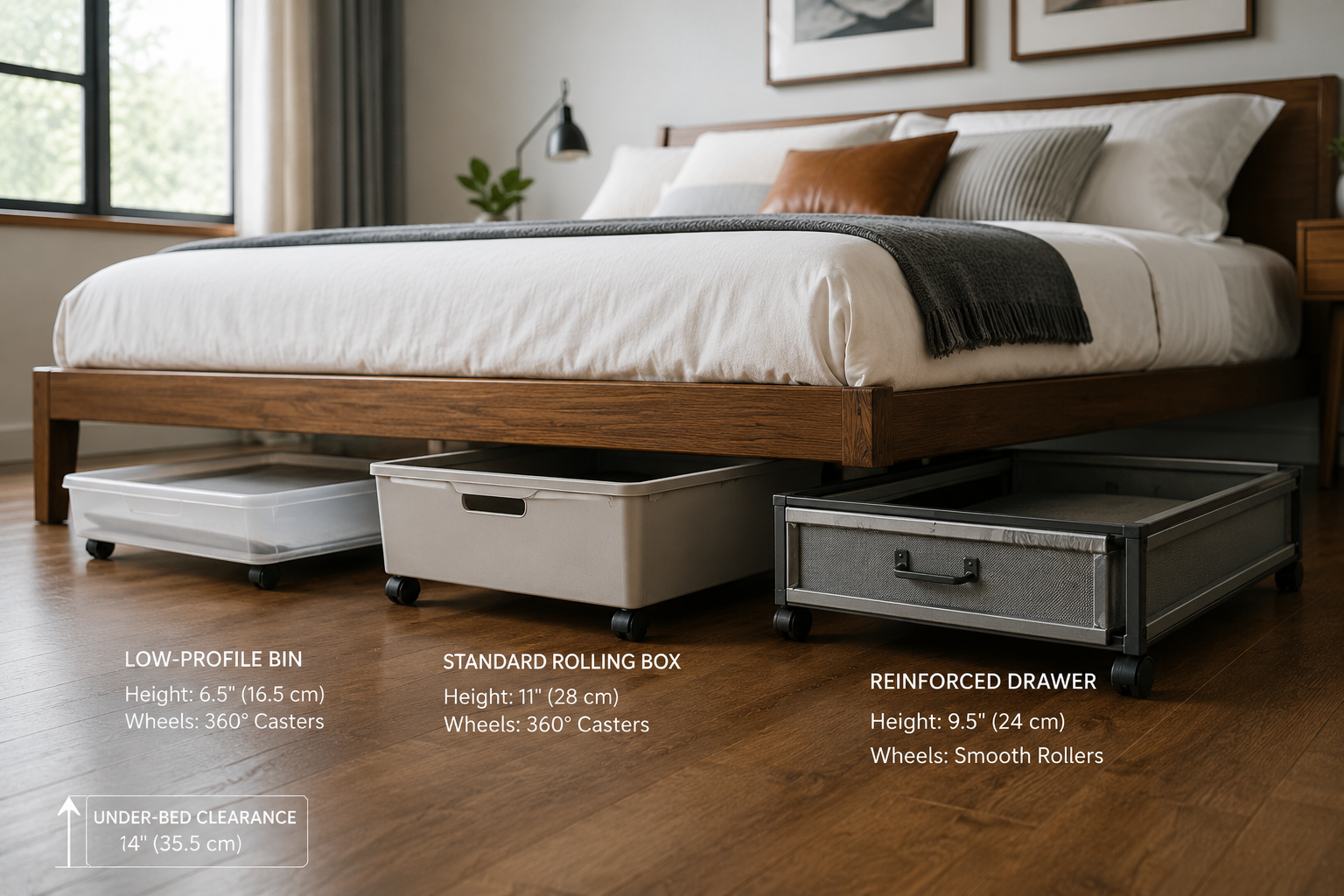
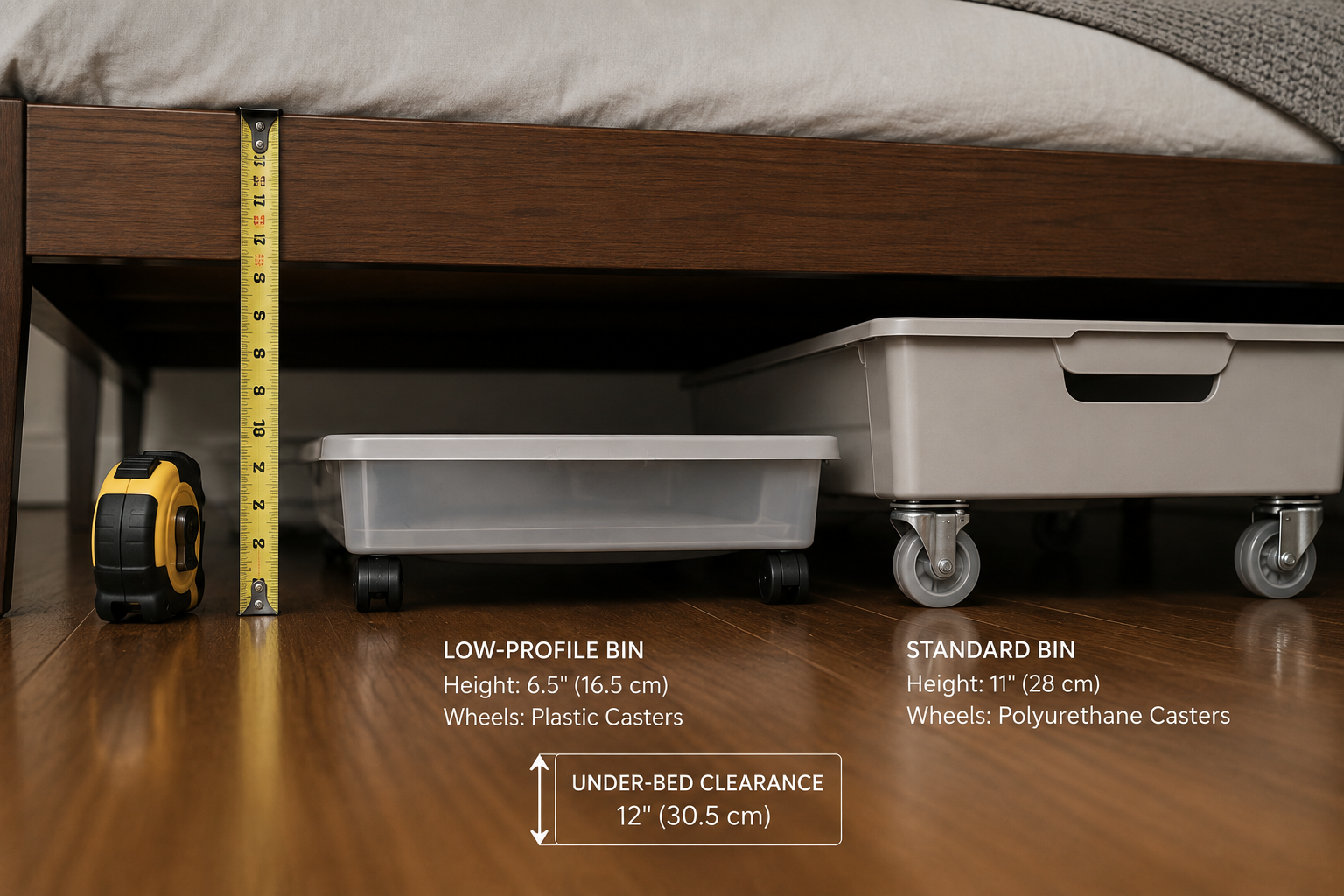
- Measure vertical clearance: Use a rigid ruler or tape measure from your floor to the lowest solid spot under your bed frame. Include any bedding or bed skirt in your estimate. Most beds measure between 6 and 13 inches of clearance at their lowest point.
Low-profile beds may have only 6-7 inches, while traditional or captain’s beds offer up to 12-13 inches.
Measure maximum usable length and width: Measure between the inside of the bed legs (or any support rails) for length, and from side to side for width. Most containers are 30–34 inches long and 18–20 inches wide, but some frames require shorter/lower-profile bins.
Allow for wheel height: The wheel or caster adds 0.5 to 1.5 inches to the bin’s height. Do not ignore this when matching bins to clearance.
Map your measurements to the three main market categories:Measured ClearanceRecommended Bin TypeProduct Example (Exterior Size)6–7 inSlim/Low-profile rolling boxSterilite 56-qt (33.75 × 18.75 × 7 in)8–10 inStandard rolling under-bed binIRIS Easy Access (32 × 17 × 9.5 in)11–12 in+Reinforced/deep drawer unit or premium binYik Metal Frame Fabric Drawer (33.9 × 17.7 × 11.2 in)
For more on measuring, see our complete storage measuring guide.
Step-by-Step Guide: Finding Your Perfect Rolling Under-Bed Storage
Follow these practical steps to eliminate fit issues, dial in the right features, and reduce your chances of a return.
Plan what you’ll store first. Decluttering beforehand will help you decide on the right bin type and how many are truly needed (see: how to declutter a small home).
Measure your space (see previous section). Write down the lowest vertical clearance and the usable length/width.
- Decide what you require:
- If mostly soft/compressible items (blankets, off-season clothes): low-profile or standard bins—or vacuum storage for tightest spaces
- For heavier items or frequent use: reinforced frame bins or deep drawer systems
Select the wheel type by floor surface:- Hard floors (wood, tile): polyurethane or metal-reinforced casters prevent scratches and noise
- Carpet: Larger wheels or more wheels (6–8) for smooth rolling; consider bins that run on rails
Check for lid and seal quality: Choose rigid, dust-proof lids for frequent access; zippers for lightweight textile storage; vacuum valves for seldom-accessed, compressible items.
Read the load rating: For heavy items or stacks, pick a bin with a clear per-unit capacity (60–100 lb for premium bins).
Confirm accessibility/ergonomic needs: Pull rails, soft-grip or magnetic-release lids, and extended handles reduce bending/straining.
- Check price band versus quality:
- Budget ($15–$20): OK for light storage under standard beds
- Mid-premium ($50–$80): More casters, metal reinforcement, higher durability
Expect 10–25 minutes assembly time (for bins requiring caster installation); always do a test roll—both empty and loaded—to confirm smooth operation before filling with items or stacking bins.
Want more on organizing? See our closet organizer system guide for holistic solutions.
How Wheel Count, Wheel Material, and Brakes Affect Mobility and Durability
The mobility of your under-bed storage depends on both the number and quality of wheels. Here’s how to choose wisely:
- Minimum 4 casters for stability; bins over 30 in length are best with 6–8 casters for even weight support [2].
- Wheel materials: Polyurethane or metal-reinforced casters are longer-lasting and quieter on hard floors; budget bins often use hard plastics, which are prone to cracking and poor rolling [4].
- Locks/Brakes: Lockable casters keep bins stationary while you load or sort contents.
- Floor compatibility: Hard plastic wheels can scratch hardwood/laminate. Always test rolling fully loaded and consider adding felt pad or choosing poly casters for sensitive floors. On carpet, larger wheels or rail-based systems work best.
Look for weight ratings: High-quality bins state a safe load-per-unit and sometimes per-caster.
| Wheel Material | Pros | Cons | Best For |
|---|---|---|---|
| Plastic | Affordable, lightweight | Prone to cracking, noisy, can scratch floors, poor on carpet | Budget, light loads, infrequent use |
| Polyurethane | Quiet, smooth, durable, floor-safe | Usually higher cost | Hardwood/laminate, daily/frequent access |
| Metal-Reinforced | Very durable, supports heavy loads | Can be heavy, costliest, sometimes harder to assemble | Heavy/stacked storage, carpet, maximizing longevity |
Get more advice on bedroom storage optimization and garage storage on a budget.
Weight Capacity and Structure: Soft-Sided vs Rigid Boxes vs Reinforced Frames
Match your load to the container’s structure for safe, long-lasting storage:
- Soft/fabric bags: Good for lightweight, compressible items (blankets, linens); not for heavy loads—these lose their shape and are easily damaged [3].
- Rigid plastic boxes: Suitable for mixed loads (clothes/shoes/toys); e.g., Sterilite 56-qt fits most standard beds and holds up to 66 lb [4].
- Reinforced metal-frame units: Designed for heavy/dense items, support up to 66 lb (Yik), and sometimes 100 lb for premium plastic bins [5].
| Item Type | Recommended Construction | Typical Load Rating | Example Use |
|---|---|---|---|
| Lighter clothes, textiles, linens | Soft/fabric bag, low-profile bin | 15-25 lb | Seasonal clothes/blankets |
| Shoes, books, mixed | Rigid plastic box | 40-66 lb | Regular closet overflow |
| Heavy stacked items | Metal-frame drawer unit, reinforced bin | 66–100 lb | Toys, tools, gear |
See also: Pantry and closet storage construction tips.
Dust, Moisture and Sealing: Lids, Zippers, and Vacuum Options
Keep your stored items protected by prioritizing the right closure:
- Lidded plastic bins offer best dust and moisture defense for everyday items; ensure lid fits tightly, without warping [4].
- Vacuum storage bags use compression valves to save space (great for off-season duvets or coats), but are less convenient for frequent access. Look for sturdy zippers and one-way valves.
- Drawer units (on rails) can be dust-tight if well-designed, but check user reviews for gaps or loose closures.
| Option | Pros | Cons | Best Use |
|---|---|---|---|
| Lidded Rolling Bin | Visible, dustproof, frequent-access easy | More total space required; lid can warp | Everyday and mixed storage |
| Vacuum Storage Bag | Max space-saving; compress bulky textiles | Less user-friendly for regular access; zipper can fail | Seasonal, rarely-used items |
| Drawer Unit (Rails) | No wheels to jam; easy sliding; less heavy lifting | May need assembly; rails not universal fit | For limited mobility, frequent access |
For more waterproof storage or best practices with vacuum bags, visit our vacuum storage bags guide.
Accessibility and Ergonomics — Best Options for Limited Mobility and Frequent Access
If you have mobility constraints or want gentler access, these features can make all the difference:
- Pull-out drawer units on rails or telescoping sliders—reduce reaching and crouching compared to bins on wheels.
- Recessed, soft-grip handles or magnetic-release lids—require less force to open than snap lids or tight zippers.
- Long pull handles for users with limited reach or grip strength.
- Swivel locks to keep containers stationary as you access contents.
- Stack-and-nest modular bins—easy to add or remove without repurchasing if you change beds.
For users who want the lowest bend or least hand force, ask sellers: “Does this bin offer a pull-rail, soft/open lid, or extended handle option?”
More ideas: Small bedroom accessibility solutions.
Price Bands, Representative Examples and Trade-Offs
Set realistic expectations based on price band and intended use:
| Type | Price Range | Features | Use Case |
|---|---|---|---|
| Budget plastic bins (Sterilite) | $15–$20 | Plastic wheels, basic lid, ~56–66 qt, 4 wheels | Light/medium loads, standard clearance, occasional access |
| Mid-range metal-reinforced/fabric bins | $45–$60 | 6–8 poly/metal wheels, reinforced frame, lockable, 66 lb | Heavy items or more frequent rolling |
| Premium deep drawers/rigid premium plastic | $65–$100 | Heavy-duty casters, premium frame, > 100 lb, advanced features | Frequent use, high loads, accessibility priority |
Trade-offs: Budget bins are cost-effective, but plastic wheels and lids break down faster if used daily on hard floors. Premium products cost more upfront, but users report far fewer issues with wear, misfit, or noisy rolling [1].
Common Buyer Mistakes and How to Avoid Them
The top sources of disappointment for rolling under-bed storage are:
- Not measuring full clearance (forgetting to include wheel height) so the bin won’t fit under the bed.
- Using soft/fabric bins for heavy storage—these sag or rip under weight.
- Expecting smooth rolling on carpet with small plastic wheels—choose large, metal-reinforced or polyurethane, or consider rails.
- Overstuffing bins—causes warping/lid failure; get a slightly larger size, or use vacuum bags for bulky items.
- Buying before organizing or decluttering—results in unnecessary returns. Always plan your contents first.
| Mistake | How to Avoid |
|---|---|
| Missed measuring clearance/wheel height | Write down vertical space; compare to product height including wheels before buying |
| Chosen fabric for heavy items | Pick rigid or reinforced-frame bins for weight/stacks |
| Picked small plastic wheels for carpet | Choose larger wheels or rail system for carpet/fuzzy rugs |
| Overfilling bins | Choose larger or reinforced bins; use vacuum bags for compression |
| Bought before organizing | Declutter and plan the precise contents first; use our decluttering steps |
See more organizing tips in our modular closet system roundup.
Assembly, Installation, and Floor Care Tips
Quick setup for your new rolling under-bed storage:
- Unbox and confirm all wheel hardware and frame components.
- Follow included instructions carefully—some bins take 10–25 minutes to assemble; missing fasteners, though rare, are most often found in mid-premium models.
- On hardwood/laminate: Use bins with polyurethane wheels, or add a felt pad under each wheel to avoid scratches and noise. For carpet: Go for larger wheels or supplement with a slippery baseboard/rail.
- Always do a test roll fully assembled both empty and partly loaded—move forward and backward to check for unexpected jams or floor scuffing. Only then fill with items.
- Wipe bins down regularly; clear debris from wheels which can get caught and scratch floors or impede rolling.
Want to go deeper? See our guide to floor-safe storage accessories and garage organization on a budget.
Ultimate Quick Shopping Checklist
Use this checklist when comparing and purchasing under‑bed storage with wheels:
- ☐ Measured bed’s vertical clearance (add wheel height!) and length/width between legs/rails
- ☐ Confirmed necessary capacity for your actual items (clothes, books, seasonal)
- ☐ Matched storage type: low, standard, or deep bin/drawer to your space
- ☐ For heavy or stacked loads, selected rigid or reinforced bin with a stated load rating (e.g., 60–100 lb)
- ☐ 4 casters minimum; 6–8 for bins over 30″ in length
- ☐ Polyurethane or metal-reinforced casters for hard floors or daily use; lockable if needed
- ☐ Quality lid or seal—snap, magnetic, zipper, or vacuum valve as preferred
- ☐ Checked for accessibility needs: pull rails, handles, low-pressure opening
- ☐ Price and return policy fit your risk tolerance
- ☐ Plan for assembly time and check floor-care recommendations
- ☐ Organized and measured your actual storage needs, not just “guesstimating”
Download this as a printable checklist, or save it for quick reference during your next under-bed storage purchase.
FAQs
How much clearance do I need to fit a rolling under‑bed bin?
Measure the distance from the floor to the lowest part of your bed frame and subtract 0.5–1.5 inches to account for the wheels. If your clearance is 6–7 inches, stick to low-profile bins. Standard bins fit 8–10 inch clearances, while reinforced/deep bins need at least 11–12 inches.
Will wheeled under‑bed storage roll well on carpet or damage hardwood floors?
Small hard-plastic wheels can struggle on carpet and may scratch hardwood/laminate. For carpet, choose bins with larger or more wheels (6–8), rails, or a sliding base. For wood floors, opt for polyurethane or metal-reinforced casters and test with a felt pad if needed.
How much weight can under‑bed storage boxes with wheels safely hold?
This varies: most budget rigid bins are rated for up to 40–66 lb (Sterilite 56-qt is a typical example). Premium reinforced bins can handle 60–100 lb. Always check the specific capacity and avoid overloading to protect wheels and lids.
Are lidded rolling bins better than vacuum bags for seasonal clothes?
Lidded rolling bins are best for frequent access and quick organization. Vacuum bags maximize space for bulky or rarely accessed items (like winter blankets) but are slower to open/close. For daily or frequent access, use lidded bins; for off-season storage, vacuum bags excel.
What caster features should I look for to avoid wobbling and noisy wheels?
Look for at least four (preferably six–eight for long bins) polyurethane or metal-reinforced casters, lockable wheels, and bins with an even, rigid frame—these features reduce noise, wobble, and rolling issues on most floors.
With a measurement-first approach and evidence-backed features, you’ll choose under-bed storage with wheels that fits perfectly, rolls smoothly, and endures for years, with less hassle and fewer returns. Shop smart and reclaim hidden space the expert way.