

Table of Contents
- Why Small Homes Amplify Clutter
- Start With the One-In-One-Out Rule
- The 4-Box Method: Your Decluttering Engine
- Room-by-Room Declutter Checklist
- Tips for Maintaining a Clutter-Free Home Long-Term
- You Don’t Need More Space — You Need Less Stuff
There’s a reason clutter feels so suffocating in a small home. When every square foot has a job to do, even a handful of misplaced items can make a compact space feel chaotic and unlivable. The good news? Knowing how to declutter a small home is less about having more space and more about being intentional with the space you already have. Whether you’re living in a studio apartment, a cosy terraced house, or a compact flat, this step-by-step system will help you clear the chaos room by room — and keep it that way. Remembering the importance of a how to declutter a small home will help.
Why Small Homes Amplify Clutter
In a large home, clutter has somewhere to hide. Spare bedrooms become dumping grounds, oversized garages absorb the overflow, and wide hallways can absorb a coat rack without anyone blinking. In a small home, there is no such buffer. Every item is visible, every surface is prime real estate, and the psychological weight of clutter is felt much more intensely. Remembering the importance of a how to declutter a small home will help.
Research consistently links visual clutter to elevated cortisol levels — meaning a messy small space isn’t just annoying, it’s genuinely stressful. Small space organization isn’t a luxury; it’s essential for your wellbeing. The first step is understanding that decluttering a small home isn’t about ruthless minimalism — it’s about intentional decluttering: keeping only what earns its place. Remembering the importance of a how to declutter a small home will help.
Start With the One-In-One-Out Rule
Before you box up a single item, commit to the single most powerful habit for small-home living: the one-in-one-out rule. Every time something new enters your home — a new pair of shoes, a kitchen gadget, a decorative candle — one existing item must leave. This isn’t about deprivation; it’s about maintaining equilibrium. Remembering the importance of a how to declutter a small home will help.
Applied consistently, this rule means you’ll never need a major declutter session again. It keeps the volume of your belongings stable and forces you to make deliberate purchasing decisions. Pair it with a running donation box in a cupboard, and you’ll find that letting go becomes second nature.
The 4-Box Method: Your Decluttering Engine
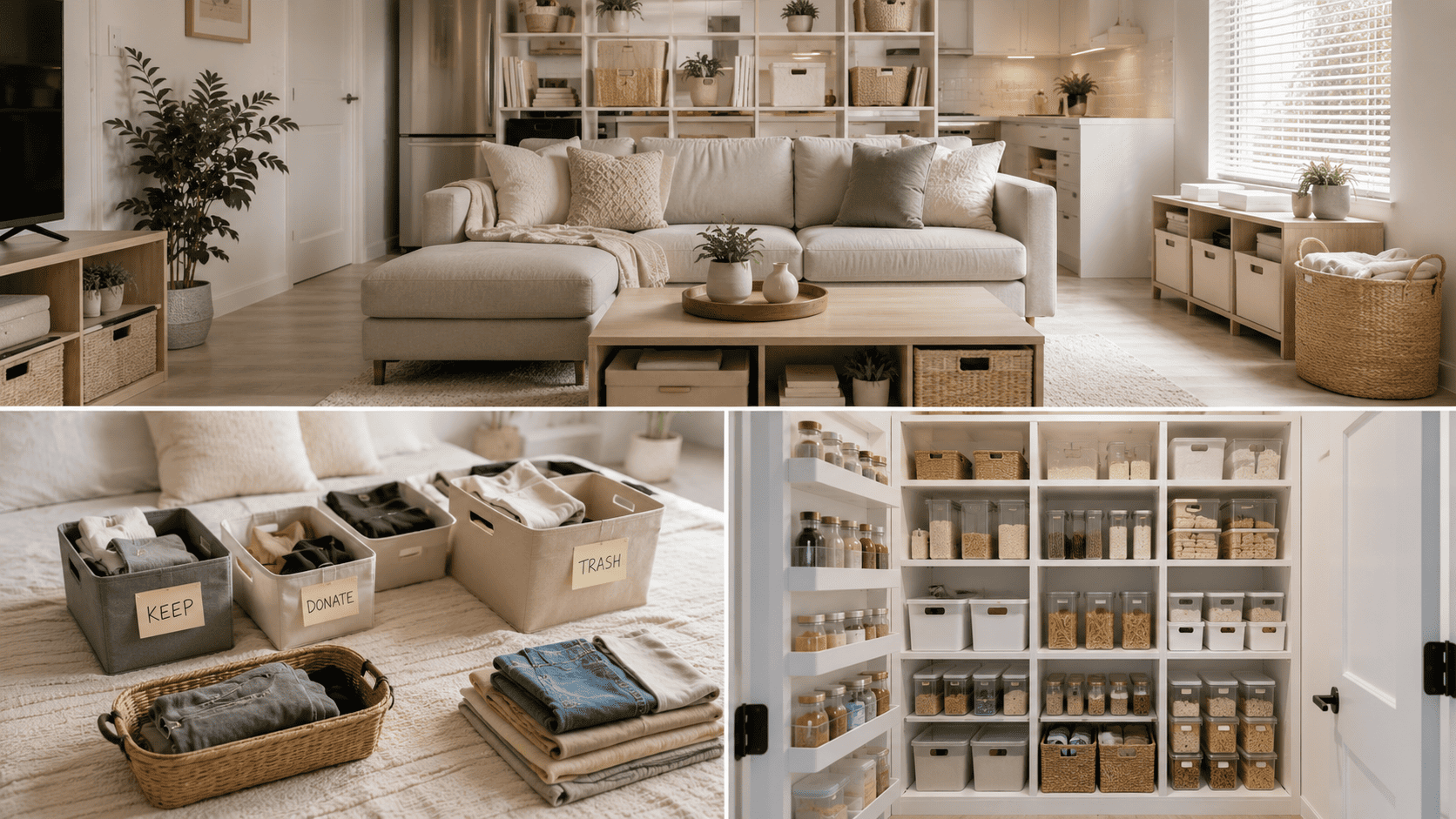
Before diving into your room-by-room declutter guide, set up your four boxes (or bags). Label them clearly:
- Keep — Items you use, love, or genuinely need.
- Donate/Sell — Items in good condition that someone else could use.
- Bin — Broken, expired, or damaged items with no second life.
- Relocate — Things that belong in a different room entirely.
Work through each room with these four boxes beside you. Don’t second-guess yourself — if you haven’t used something in over a year and feel no emotional attachment to it, it goes. Speed matters here: if you want to know how to get rid of clutter fast, the 4-box method is your best tool. Set a timer for 25 minutes per room and move with purpose.
Room-by-Room Declutter Checklist
Kitchen
The kitchen is often the worst offender in a small home. Duplicate utensils, expired pantry items, and gadgets used once a year all compete for precious drawer and worktop space.
- Clear every worktop surface — nothing lives there permanently except essentials.
- Go through cupboards and discard expired or duplicate items.
- Audit gadgets: if it can be done with a knife or a pot, the single-use gadget goes.
- Organise what remains by frequency of use — daily items at eye level, occasional items up high.
Once your kitchen is decluttered, a well-organised pantry transforms everything. Explore these pantry organization ideas to maximise every shelf and make meal prep genuinely enjoyable.
Bedroom
Your bedroom should be a sanctuary, not a storage unit. In small homes, bedrooms often absorb the overflow from other rooms — and that creep needs to stop.
- Pull everything out from under the bed and assess it honestly.
- Declutter your wardrobe ruthlessly: if it doesn’t fit, flatter, or get worn, it goes.
- Clear nightstands to a maximum of three items each.
- Remove any items that belong in other rooms (gym gear, paperwork, hobby supplies).
After decluttering, the right storage approach makes all the difference. Discover smart storage solutions for small bedrooms that use vertical space and under-bed areas without adding visual noise. And if your wardrobe is a recurring trouble spot, investing in the best closet organization system for your space will save you time and frustration every single morning.
Bathroom
Bathrooms accumulate expired products, duplicates, and items kept “just in case” at a remarkable rate. A small bathroom declutter can be completed in under an hour.
- Check every product for expiry dates and dispose of anything past its prime.
- Consolidate duplicates — you don’t need four half-empty bottles of the same shampoo.
- Remove anything that doesn’t belong (spare towels can live in a linen cupboard).
- Limit your countertop to daily-use items only.
With the clutter gone, vertical organisers, magnetic strips, and over-door storage can dramatically expand how much your bathroom can hold without feeling cramped.
Living Room
The living room is the heart of the home and the first space guests see — yet it’s often where miscellaneous clutter accumulates unchecked.
- Rehome anything that doesn’t belong: shoes, bags, mail, and dishes all have proper places.
- Audit decorative items — choose pieces that genuinely bring joy or serve a function.
- Tame cable clutter with clips and managed routing.
- Reduce the book or magazine pile to a curated selection you’ll actually revisit.
Multi-functional furniture — ottomans with storage, shelving that doubles as display — is your greatest ally in the living room. Think vertically, and every wall becomes an opportunity.
Tips for Maintaining a Clutter-Free Home Long-Term
Decluttering is a sprint, but maintaining a clutter-free home is a marathon. These habits will keep your small space feeling open and calm week after week.
- Do a weekly 15-minute sweep. Walk through each room and return items to their rightful place. Small, consistent effort beats the occasional mega-session.
- Use a declutter checklist for home on a quarterly basis. Revisit each room every three months with fresh eyes — what served a purpose in January may not in April.
- Shop intentionally. Before buying anything, ask: Where will this live? What will it replace?
- Invest in sustainable storage systems. Quality, adaptable storage means you won’t constantly be rearranging cheap solutions that don’t hold up. Consider sustainable storage solutions that are built to last and kinder to the environment.
- Involve everyone in the household. A decluttered home only stays that way if everyone shares the same systems and values the same standards.
You Don’t Need More Space — You Need Less Stuff
The most common mistake small-home dwellers make is believing that their problems will be solved by more storage. More bins, more shelves, more cupboards. But storage without decluttering is just organised chaos. The real transformation happens when you first reduce what you own, then organise what remains with purpose. A small home, thoughtfully curated, can feel more spacious, more restful, and more you than a large home ever could.
Ready to take the next step? Start today with just one room — set your timer, grab your four boxes, and work through your declutter checklist for home. You’ll be amazed at how quickly momentum builds. And once the clutter is cleared, explore the rest of this site for room-by-room organisation strategies that will help you make the very most of every inch you have.