

Bamboo kitchen organizer products are now a proven, durable, and food-safe way to replace plastic kitchen storage — but only if you buy certified, correctly sized items and follow simple maintenance. Below you’ll find an up-to-date, buyer-first guide showing exactly which bamboo items to buy, what certifications to insist on, and how to keep them food-safe and looking sharp for years.
Ready to ditch plastic for a greener, longer-lasting kitchen? This guide answers your core purchase questions and makes comparison and replacement easy.
Key Takeaways
- Bamboo kitchen organizers are a sustainable, durable replacement for plastics if you choose FSC- and food-contact certified options matched to your drawer or shelf size.
- Insist on proof of certifications (FSC, FDA or LFGB/REACH) and water-based, food-safe finishes before purchase; check return policy for sizing or finish issues.
- Prevent warping or mold with a routine of wiping dry after use and applying mineral oil every 2–3 months; expect higher upfront cost but real sustainability benefits.
- Quick verdict and the single best next step
- Which bamboo product types replace which plastic items — quick mapping
- Certifications and safety standards to insist on (by market)
- Common buyer pain points and how to avoid them (practical mitigation)
- How bamboo compares to plastic and metal — tradeoffs buyers should know
- Real maintenance routine — step-by-step (what to do and how often)
- Pre‑purchase checklist and measurement guide
- How to vet suppliers and what to ask before you buy
- Where bamboo typically fails and when to pick an alternative
- Short shopping plan and 48‑hour purchase checklist
- FAQ
Quick verdict and the single best next step
Yes, you can confidently replace most plastic kitchen organizers with bamboo kitchen organizer products — if you first measure your storage space and verify that the product you buy carries both third-party sustainability (FSC) and food-contact safety certifications (FDA, LFGB, or REACH, as appropriate). This ensures you get a durable, safe, and appropriately fitting alternative.
- One-minute verdict: Bamboo is now 7% of organizers sold, and backed by $450M US and €380M EU spending in 2025 (source), providing a viable, low-waste swap if you check certifications and match measurements.
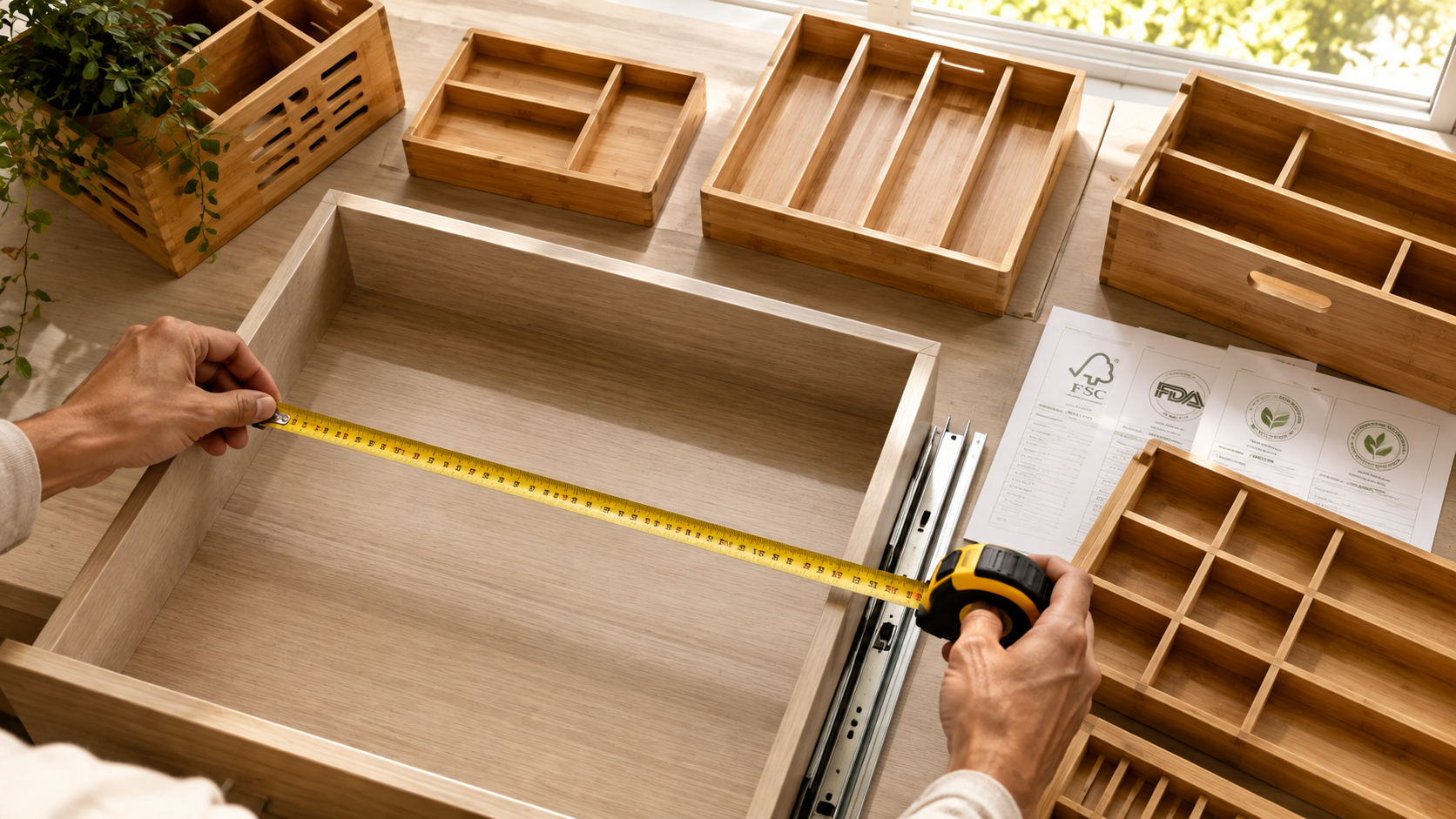
- One-step action: Measure your drawer, shelf, or pantry width/depth/height, then check the seller’s FSC, FDA/LFGB, and finish details before buying.
measurement worksheet or see our pre-purchase checklist below to avoid the most common mistakes.
Which bamboo product types replace which plastic items — quick mapping
Here’s exactly where and how bamboo kitchen organizers can substitute for plastics, and where caution is needed.
| Plastic Item | Bamboo Alternative | Caution / Fit Note |
|---|---|---|
| Utensil tray/divider | Bamboo drawer dividers | Measure internal drawer width/depth; check adjustment range. |
| Pantry storage basket | Bamboo pantry organizer | Best for dry goods; confirm moisture resistance and food-contact certification. |
| Shelf riser/organizer | Bamboo shelf organizer | Check shelf height and weight rating. |
| Food storage container | Bamboo food storage container (dry/snacks) | Use only those marked food-contact safe (FDA/LFGB); not always microwave/freezer safe; confirm lid seal. |
| Utensil holder | Bamboo utensil organizer/holder | Hand-wash and dry only, avoid soaking; check base for drainage if wet utensils stored. |
For more creative swaps and material-specific options, see our eco-friendly organizers guide.
Certifications and safety standards to insist on (by market)
To ensure your bamboo kitchen organizer is food-safe, responsibly sourced, and legal for kitchen use, always require these certifications:
- United States: FDA food-contact compliance, FSC chain-of-custody, CARB Phase 2 or TSCA Title VI for low formaldehyde/VOC emissions.
- European Union: LFGB food-contact safety, REACH compliance, FSC chain-of-custody.
- UK/Canada/Australia: Request FSC, plus either FDA or LFGB/relevant equivalent. BRCGS Packaging and ISO 14001 for commercial/retail supply where possible.
- Always ask to see actual lab test reports for food-contact items (source).
- If storing food, insist on E0/E1 formaldehyde emission ratings and a water-based, food-grade finish.
- Review our detailed certifications explainer for examples and what each standard means.
Common buyer pain points and how to avoid them (practical mitigation)
Typical issues with bamboo kitchen organizers include mold, warping, lacquer peeling, faint odors, and sizing mismatches. Nearly all can be prevented or fixed with the following steps:
- Mold or warping? Stick to high-grade, food-grade bamboo with a water-based lacquer finish. Always hand-wipe and dry immediately after contact with moisture; never soak.
- Lacquer peeling/cracking? Apply mineral oil or food-grade oil every 2–3 months to replenish the finish. Avoid harsh detergents. Choose suppliers offering LFGB/FDA documentation and ISO 14001 manufacturing where possible.
- Sizing/fit issues? Always check internal drawer or shelf dimensions and the product’s specification sheet. Leave up to 1/8″ (3mm) clearance for easy fit.
- Faint chemical odor? Avoid cheap imports with unverified coatings. Stick to reputable brands disclosing food-contact and emissions test results.
- Upfront cost or ongoing maintenance? Budget for mineral oil, and make maintenance a calendar event. A little care prevents most problems (full care guide here).
How bamboo compares to plastic and metal — tradeoffs buyers should know
Bamboo, plastic, and metal each have unique strengths and limitations in kitchen storage. Here’s what matters for sustainable, safe, and practical choices.
| Feature | Bamboo | Plastic | Metal |
|---|---|---|---|
| Eco/Safety | Sustainable, biodegradable, low VOC; food-safe if certified | Cheap, some BPA risk unless BPA-free; not biodegradable | Durable, recyclable, may leach metals if uncoated |
| Durability | Long-lasting with care; dislikes high moisture | Waterproof, low-maintenance, scrubbable | Very tough, low maintenance, holds heavy loads |
| Cost | Higher upfront, ongoing minor oiling | Lowest cost, mass-market | Varies (often close to bamboo); heavy |
Bottom line: Bamboo is best for visible drawer organization, pantry shelving, utensil trays, and dry-food storage. Prefer plastic or metal for high-moisture or freezer use unless a bamboo product explicitly says it’s rated for those conditions. For a detailed look, see Plastic vs Bamboo vs Stainless: kitchen storage tradeoffs.
Real maintenance routine — step-by-step (what to do and how often)
Keeping your bamboo kitchen organizer in top shape is easy and quick:
- Daily/After Use: Wipe with a damp cloth and dry immediately. Avoid leaving moisture or crumbs in crevices.
- Monthly: Inspect for any signs of moisture buildup, mold, or odors.
- Every 2–3 Months: Apply a thin coat of mineral oil or food-grade oil with a soft cloth — this restores water resistance and sheen.
- Always: Avoid soaking or putting in the dishwasher. Skip prolonged exposure to steam. For extra-wet items, use a silicone or fabric liner.
For a printable maintenance checklist, see the bamboo care routine guide.
Pre‑purchase checklist and measurement guide (dimensions, return policy, tests)
Prevent the most common returns or mismatches with this quick worksheet:
- Measure the internal width, depth, and height of your drawer or pantry shelf. Don’t guess! Record values in inches or mm.
- Check for manufacturer’s recommended clearance for dividers or baskets — allow 1/8″ (3mm) side-to-side breathing room.
- Ask seller for copies or photos of certifications: FSC, FDA/LFGB/REACH, emission ratings (CARB/TSCA/E0/E1 as needed).
- Check that the finish is water-based and food-safe.
- Confirm return/exchange/warranty terms. Look for clear policies for fit or finish issues — not all sellers are equal.
- Read and print product care instructions ahead of time to avoid surprises.
Use this measurement worksheet or download a printable guide for speed and accuracy.
How to vet suppliers and what to ask before you buy
Reliable, safe bamboo kitchen organizer purchases start with vetting your supplier:
- Request a FSC certificate for material sourcing and see the chain-of-custody code.
- Ask for an LFGB or FDA food-contact test report (report or certificate copy; US=FDA, EU=LFGB).
- Request REACH/TSCA compliance statement and emission test results (CARB/E0/E1 as needed for indoor air quality).
- Ask whether their manufacturing site is ISO 14001 certified for environmental management.
- Check for clear care instructions and warranty period — especially for surface finish and fit.
- If buying retail, read several recent reviews for complaints about mold, warping, or finish quality.
Supplier email template:
“Hi, before purchase can you provide copies of (1) FSC certificate, (2) FDA/LFGB food-contact report, and (3) info on your finish process (water-based, food safe)? Also, do you have a return/warranty policy for fit or finish issues?”
For more on certifications, see bamboo certifications explained.
Where bamboo typically fails and when to pick an alternative
Bamboo kitchen organizers are not fully universal. Here’s when to use something else:
- Frequent or long-term water exposure/steaming? Pick plastic or stainless; bamboo can absorb and eventually warp.
- Need microwave or freezer compatibility? Only use a bamboo container if the manufacturer says it is rated as safe — otherwise, choose glass or plastic.
- Lowest cost or maintenance-free setup? Plastic may be preferable if ongoing oiling or gentle cleaning is not practical.
If your intended environment = high humidity or standing water → pick certified plastic or stainless.
If you need a container for steaming, microwaving, or freezing → only use if bamboo model is explicitly rated.
Otherwise, bamboo is suitable and highly recommended for visible, dry, and semi-dry storage.
For a more detailed breakdown, see our bamboo vs plastic comparative guide.
Short shopping plan and 48‑hour purchase checklist
Jumpstart your plastic-to-bamboo kitchen swap with this transaction-focused, risk-reducing plan:
| Day 1 | Day 2 | Buy |
|---|---|---|
| Measure all drawers, shelves, and pantry items to replace. List current items and target bamboo types. | Compare at least 3 suppliers for proper certifications. Read recent product reviews for any complaints about mold, finish, or returns. Confirm return and care policies. |
Proceed to buy the highest-rated, correctly sized, and fully certified bamboo product that matches your intended use. |
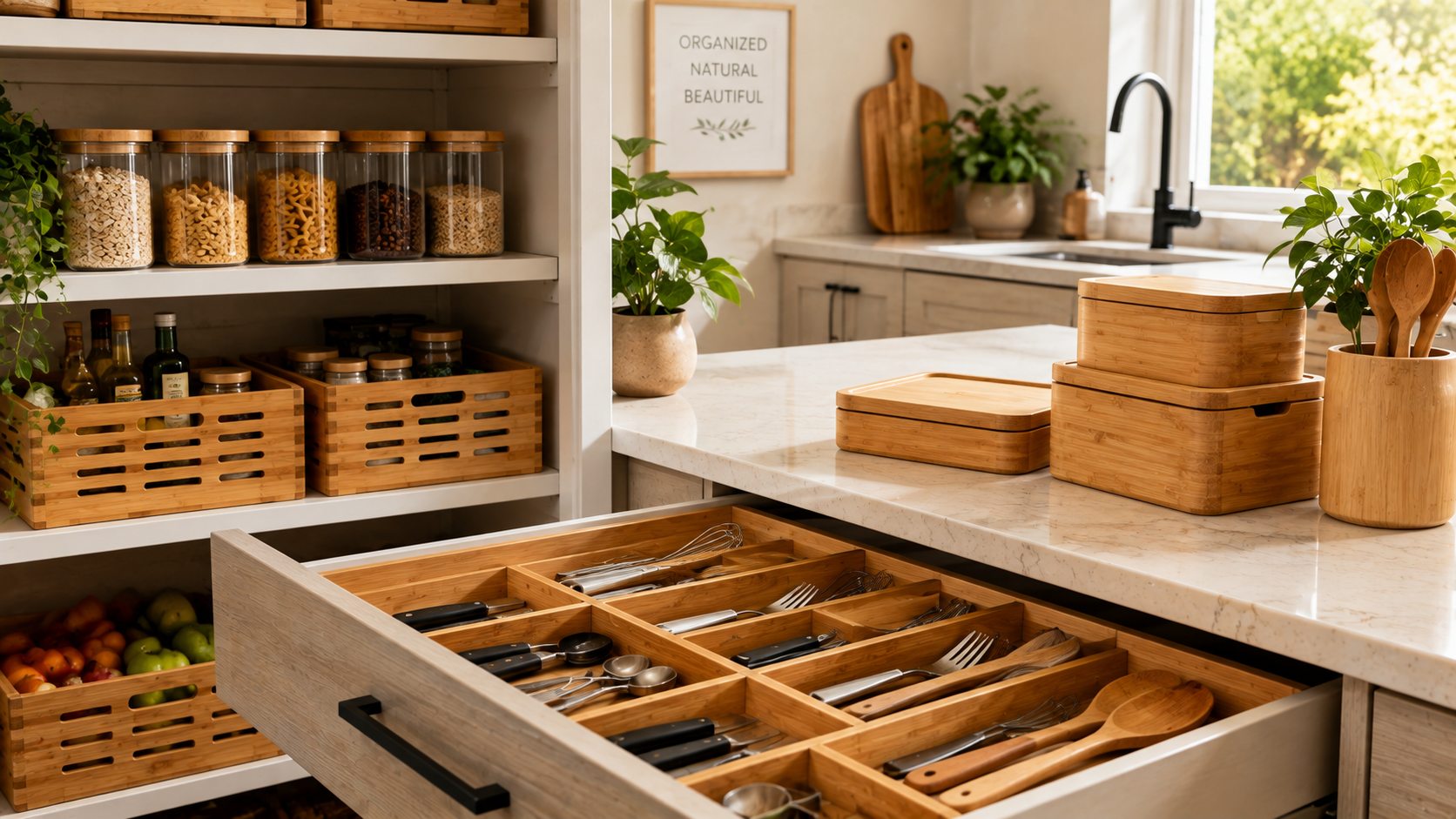
Need inspiration? See full pantry organization ideas or browse bamboo drawer dividers and pantry organizers & shelf systems for trusted picks.
FAQ
Will bamboo food storage containers make my food unsafe or contaminated?
Not if you only use bamboo containers certified as food-contact safe (FDA for US, LFGB for EU, or REACH compliant). Avoid items without verifiable lab reports or unknown coatings; stick to water-based, food-safe finishing for dry foods and snacks.
How likely is mold or warping in bamboo organizers, and how do I prevent it?
Mold and warping are rare in quality bamboo organizers if you hand-wipe and dry after each use, avoid prolonged moisture, and oil every 2–3 months. Steer clear of unsealed/cheap items and avoid storing wet items directly on bamboo.
How often do I need to oil bamboo organizers, and what oil should I use?
Every 2–3 months is ideal. Use a food-grade mineral oil or a specialist bamboo/kitchenware oil. Never use vegetable/cooking oils that can go rancid or sticky.
Which certifications should I require when buying bamboo kitchen organizers for the US vs the EU?
For the US: FDA food-contact, FSC sustainability, CARB/TSCA emissions if relevant. In the EU: LFGB and REACH food-contact, FSC sustainability. Always ask for the documentation before you purchase.
Are bamboo drawer dividers and pantry baskets worth the higher upfront price compared with plastic?
For most buyers, yes—they offer a longer aesthetic lifespan, sustainability, and safety with proper maintenance, compared to cheap plastic that can stain or crack, though expect a modest recurring cost for mineral oil and a slightly higher initial investment.
With the right certifications, measurements, and a realistic maintenance plan, your bamboo kitchen organizer will deliver sustainable performance, food-safe storage, and a visual upgrade for years to come. Ready to shop? Start by measuring your drawers today and reviewing trusted, certified suppliers for your next high-quality purchase.